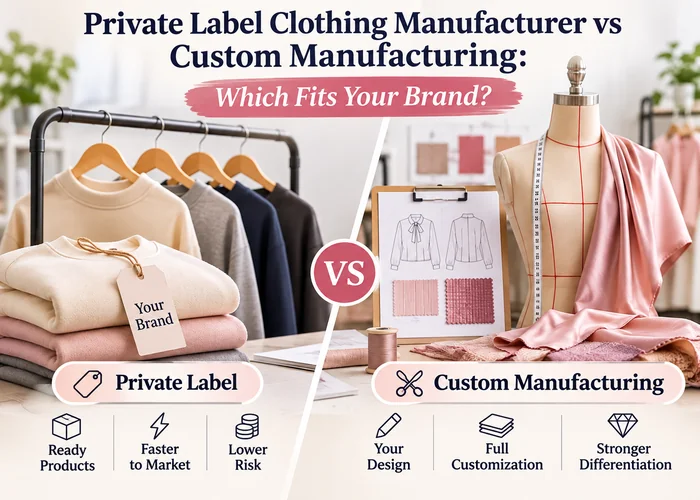
Every clothing brand faces the same fork early on: buy an existing product and put your label on it, or develop something from scratch with a factory. The two paths are sold as a simple choice — speed versus differentiation — but the real trade-offs are more specific, and they show up in places most founders don’t check until it’s too late: fabric minimums, IP ownership, reorder lock-in, and margin structure.
This guide compares a private label clothing manufacturer against full custom (full-package) production across cost, MOQ, risk and brand equity — then gives you a decision framework instead of a vague “it depends.”
The two models, defined precisely
The terms get used loosely, so let’s fix the definitions first.
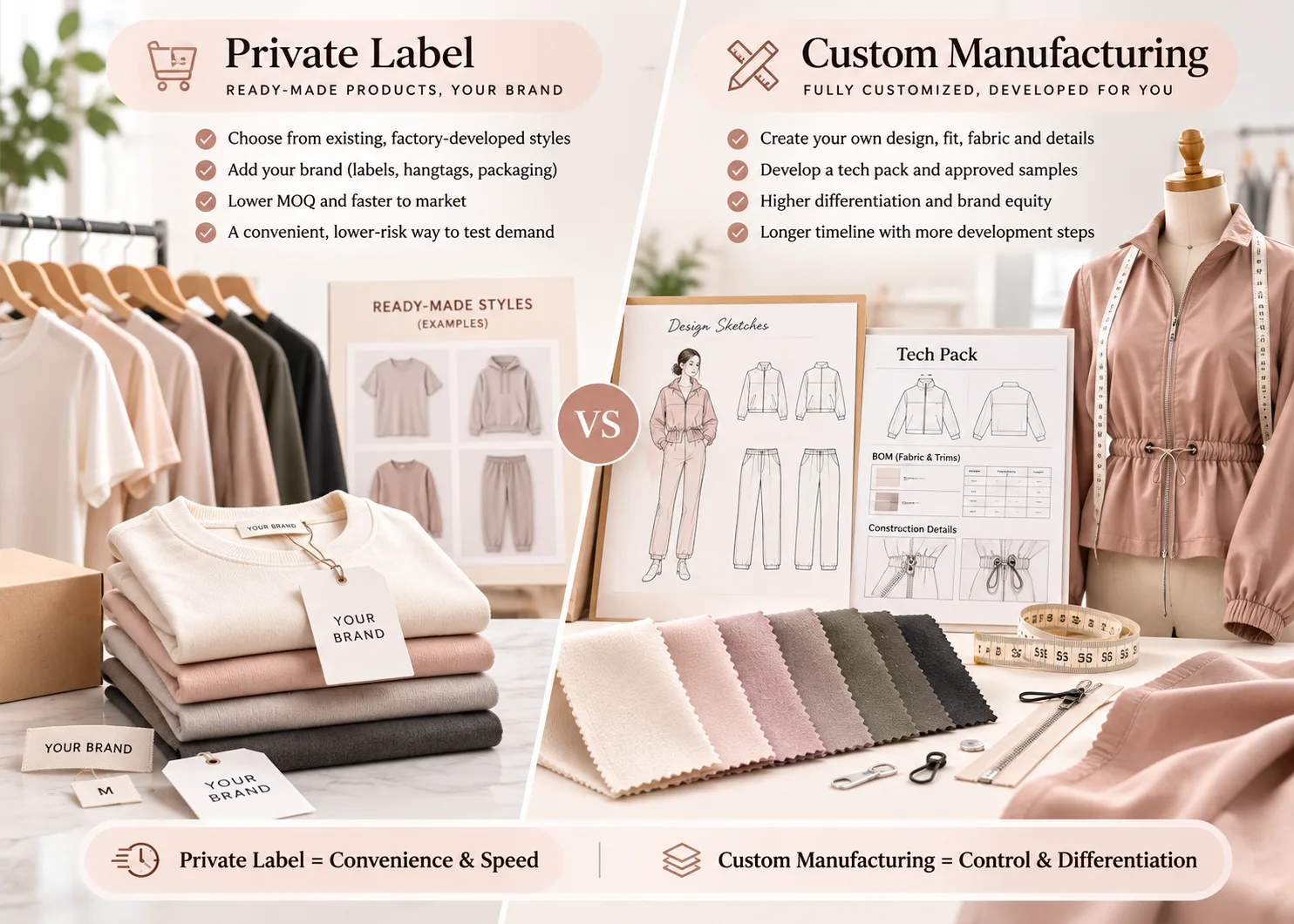
Private label (sometimes conflated with white label): you select an existing, factory-developed product — often with modification options like color, fabric or print — and sell it under your brand. The design, pattern and sometimes the tooling belong to the supplier. White label is the even lighter version: the identical product is sold to many brands, with only branding changing.
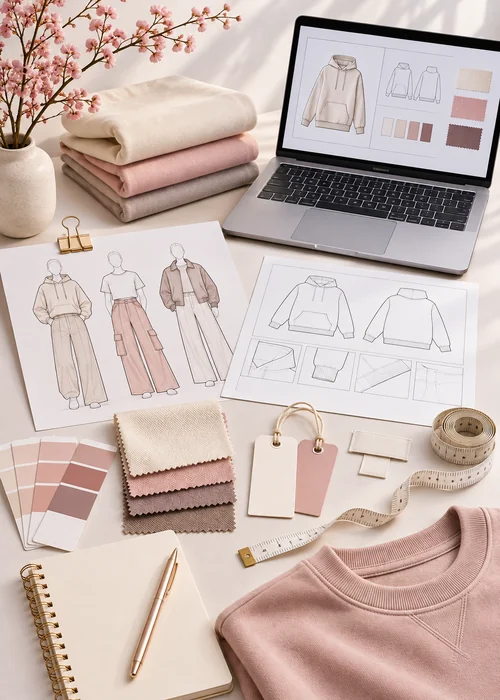
Custom manufacturing (full-package / OEM with your specs): the factory produces to your specification. You supply or co-develop the tech pack; the pattern, graded sizes and approved samples are built around your design. Done properly, you own the resulting development.
The distinction that matters commercially: who owns the product definition. In private label, the supplier does. In custom, you do.
Side-by-side comparison
| Factor | Private label | Custom manufacturing |
| Typical MOQ | 25–100 pcs/style (sometimes less) | 100–300 pcs/style |
| Unit cost | Higher relative to value; you pay for convenience | Lower at volume; setup costs front-loaded |
| Sampling | Often free or cheap — you’re sampling their product | 1–3 weeks and a fee, usually credited against bulk |
| Lead time | 1–3 weeks | 6–14 weeks including development |
| Differentiation | Low — competitors can buy the same blank | High — your patterns, fits and fabrics are yours |
| Brand equity | Builds the brand name, not the product | Builds both; your fit becomes your reputation |
| IP ownership | Supplier’s; you license the look | Yours, if contracted properly |
| Reorder risk | Supplier can discontinue or re-price the blank | Continuity depends on your spec, not their catalog |
| Best for | Testing a category, filling a range fast | Scaling a validated product |
What a private label clothing manufacturer actually provides
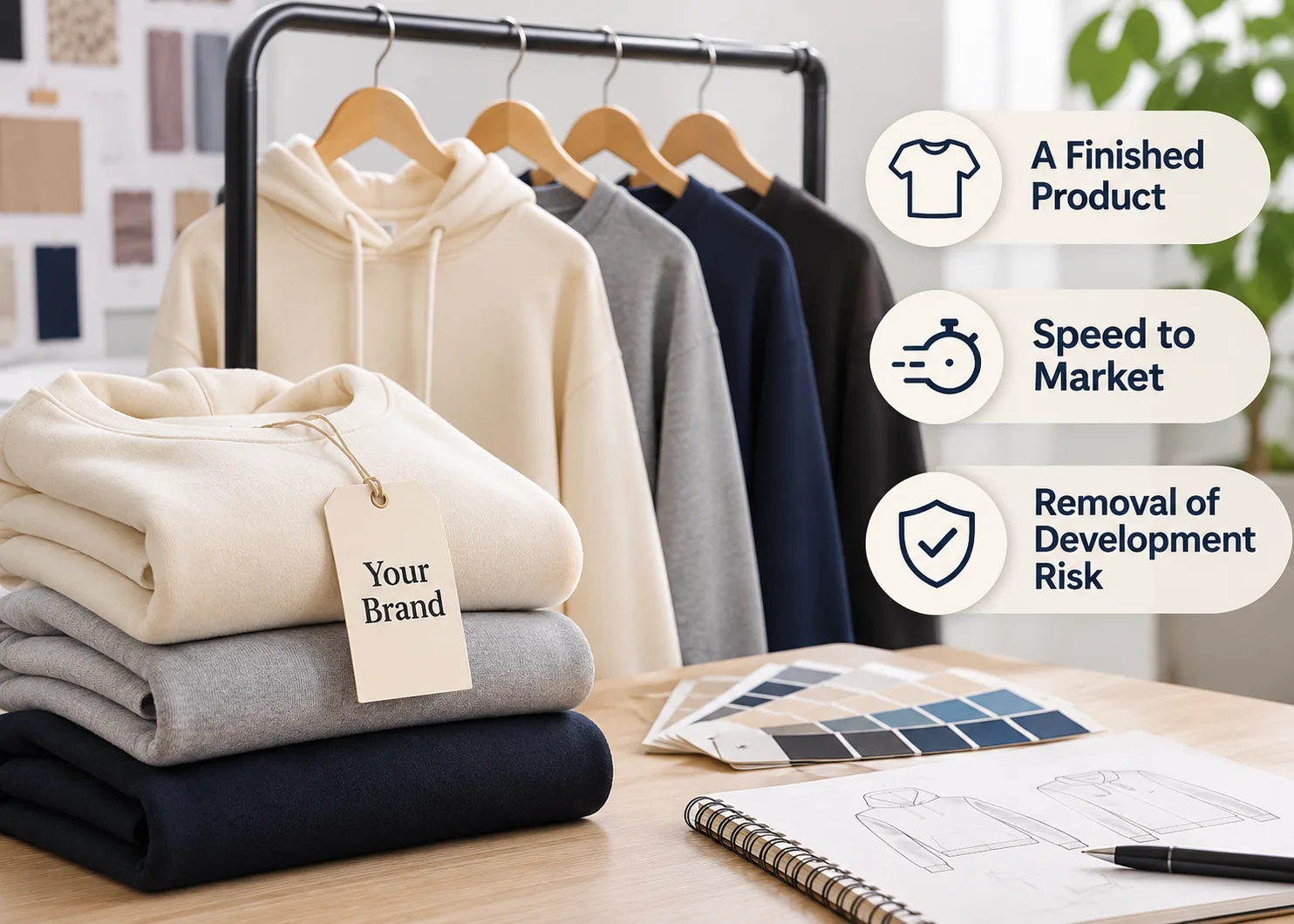
When you buy private label, you’re purchasing three things: a finished product, speed, and the removal of development risk. That’s genuinely valuable — and it’s why the model works for specific situations:
- Category testing. You can put 50 units of a hypothesis in front of customers without committing to development.
- Range filling. Your line needs a beanie to complete the winter capsule, and nobody will judge your brand on a beanie.
- Cash-flow timing. No development spend means capital goes to marketing instead.
What you are not buying is a moat. A private label clothing manufacturer sells the same base product to every brand that asks. Your differentiation is limited to branding, packaging, photography and price — all of which can be copied in a season. And the structural risk cuts the other way too: if the factory updates, reprices, or discontinues the blank, your “signature product” can vanish or change under you, with no recourse, because the spec was never yours.
What custom manufacturing costs — and what it buys
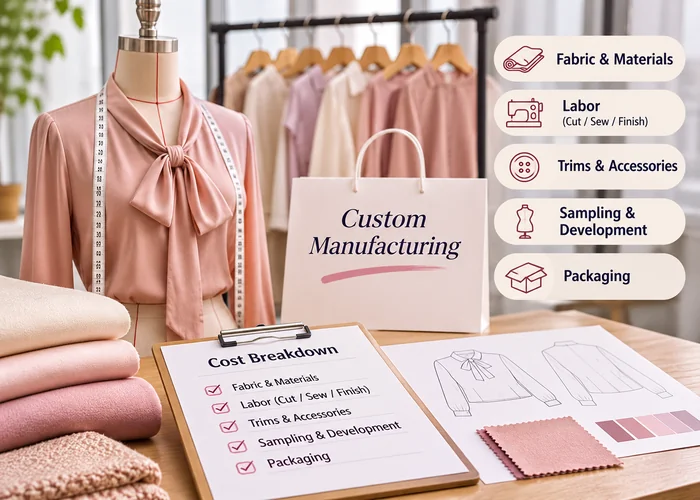
Full custom production front-loads cost and time: tech pack development, sampling rounds, fabric minimums, and 6–14 weeks before goods ship. On a per-unit basis, small custom runs typically run 15–35% above an equivalent 500-piece order, which shocks founders who compared against private label pricing.
But the comparison is mispriced if you only look at unit cost. Custom buys:
- Fit as an asset. If your top fits better than everything else in the customer’s closet, that fit — protected by your spec sheet — is the reason for the second order.
- Fabric leverage. One custom fabric can carry three styles, which is how small brands get mill-quality material at accessible minimums.
- Margin structure. A differentiated product sustains full-price selling. Blank-based products get forced into promotional pricing because the customer can find a near-identical item elsewhere.
- Continuity. Your reorder is produced from your approved PP sample and spec — not from whatever the supplier’s catalog looks like next quarter.
The decision framework: five questions
Answer these honestly and the right model usually selects itself:
1. Is the product your brand, or an accessory to your brand? If customers would describe your brand by that product (your signature scarf, your signature fit), it must be custom. If it’s the fifth item in a gift set, private label is fine.
2. Do you have demand evidence yet? No evidence → private label or a tiny custom test. Evidence → custom, before someone else copies the demand you found.
3. Can you tolerate 6–14 weeks of development? If your launch is date-driven (a holiday season, a collab), private label buys the calendar. If your launch is brand-driven, spend the time on development.
4. Who will own the spec in year two? This is the question founders skip. Private label means the answer is “the supplier.” Custom, contracted properly, means “you” — and that answer compounds.
5. What does your margin need to survive? Blank products retail at competitive prices because they compete with identical products. If your business model needs full-price sell-through, custom differentiation isn’t a luxury; it’s the pricing power.
The hybrid path most brands should take
The framing “private label vs custom” implies a one-time choice, but the durable pattern for small brands is sequenced, not either/or:
- Use private label strategically for accessories, gift items, and range fillers — products where customers don’t judge fit.
- Go custom on your hero products — the one or two items the brand will be judged on, developed properly with a tech pack and owned spec.
- Migrate winners. When a private label item sell-throughs above ~60%, develop a custom version of it: same concept, your fit, your fabric. Now the demand is proven and the product is defensible.
This sequencing also solves the cash problem: private label products fund the development of the custom line.
Brand protection in both models
Whichever path you take, two housekeeping items protect you:
- Trademark the brand name early — before labels, hangtags and packaging are printed. A rebrand after 2,000 printed units is the most avoidable cost in the industry. Register the trademark before you commit to collateral.
- Get ownership in writing. If a factory develops your pattern, samples or molds during custom production, the contract should state that you own them and can move production. If you go private label, ask what happens to your branded labeling if the blank is discontinued — and get the answer in the PO terms, not in a chat message.
Compliance responsibility also doesn’t outsource cleanly: labeling accuracy, fiber content claims and chemical compliance obligations sit with the brand selling the product, whichever model you use — the FTC’s business guidance is the right starting point for US-market obligations.
Common mistakes in this decision
- Going custom too early. Custom development without demand evidence is how brands spend $10,000 learning their niche was wrong. Test first.
- Staying private label too long. The blank that validated your concept will be undercut by the next brand that finds the same catalog — every private label clothing manufacturer serves your competitors too. Migrate winners before that happens.
- Comparing unit cost only. A $1.50 cheaper blank that forces you into discounting is more expensive than a custom piece that holds full price.
- Skipping the ownership clause. “We developed it together” is not ownership. Paper it.
- Assuming private label means no QC. Blanks fail inspections too. Whatever the model, keep a pre-shipment inspection with a photo report.
FAQ: Private Label vs Custom Manufacturing
What is the difference between a private label clothing manufacturer and a custom manufacturer? A private label clothing manufacturer sells you an existing product with your branding on it; the design and spec stay with the supplier. A custom manufacturer produces to your specification — your tech pack, your pattern, your samples — and you own the development.
Which has lower MOQ? Private label, usually 25–100 pieces per style. Custom typically starts at 100–300 pieces per style, though accessories and shared-fabric strategies can bring the effective minimum down.
Is custom manufacturing always more expensive? Per unit at small quantity, yes — roughly 15–35% above a 500-piece run. But custom products sustain full-price retail, so lifetime margin often favors custom once a product is validated.
Can I switch from private label to custom later? Yes, and it’s the recommended path: validate demand with private label, then develop a custom version of your best seller — your fit, your fabric, your spec.
Who owns the design in custom manufacturing? You do, if the contract says so. Confirm in writing that patterns, samples and tooling developed for your order belong to you and can transfer if you change production partners.
Still deciding?
Evelyn is a full-service custom manufacturing partner for apparel, scarves and accessories, and pet collections — low MOQ from 100 pieces per style, in-house fabric sourcing, and development work (tech packs, patterns, samples) that stays yours. If you’re weighing the two models for a specific product, send us the concept and we’ll tell you honestly whether it’s worth developing or better bought as a blank.